|
|
708 research and design of the worldTime:2024-04-19
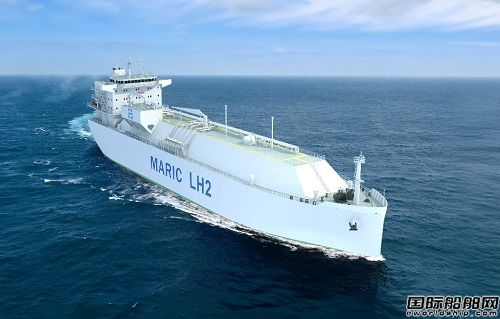
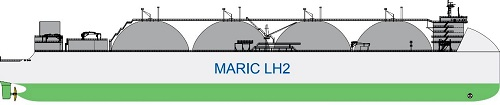
20000Cubic meter At the 2024 International Hydrogen Energy Industry Development Forum held recently, the 708 Research Institute of China State Shipbuilding Corporation Limited released the design scheme of Type 2 liquefied hydrogen carrier, which aroused strong attention from participants. The 180,000 cubic meter class and 20,000 cubic meter class liquefied hydrogen carriers released this time have completed the basic program demonstration and certification jointly with the American Bureau of Shipping (ABS), of which 20,000 cubic meter class liquefied hydrogen carriers were awarded the ABS Recognition of Principle (AiP) certificate. Hydrogen is non-toxic and combustion does not produce greenhouse gases and pollutants, with the continuous enhancement of environmental constraints, the global demand for hydrogen energy will also increase significantly. However, the cost of hydrogen production in different countries and regions varies greatly, which makes large-scale cross-border hydrogen transport become a very urgent technology, so efficient and high-purity liquid hydrogen transport vessels are an important choice for long-distance large-scale cross-border transport in the future. In response to the demand for large-scale cross-border transportation of hydrogen energy, the 180,000 cubic meter liquid hydrogen carrier released by 708 Institute is currently the world's largest liquefied hydrogen carrier. The ship has a length of about 315 meters and a width of 54 meters. V-shaped hull, design draft of 10 meters, ballast draft is not less than 9 meters. In order to minimize heat exchange as much as possible, the ship uses a two-layer spherical tank scheme with the smallest surface-area-to-volume ratio, a vacuum is pumped between the two layers of spherical shells and the insulation is filled, the evaporation rate does not exceed 0.1%, and the volume of a single spherical tank is 45,000 cubic meters.
180000Cubic meter It is planned to use diesel propulsion at a design speed of 18 knots, with light diesel (MGO) as the main fuel, with fuel tanks positioned in the bow area, while liquefied natural gas (LNG) can also be used as the fuel for propulsion if required. Proton exchange membrane fuel cell is installed in the engine room of this type of ship, and the evaporated hydrogen is used for fuel cell power generation. The cargo machinery space is arranged above the engine room, the liquid cargo equipment such as reliquefaction and compressor is arranged inside, and the waste combustion treatment unit (GCU) is arranged in the chimney area. In order to meet the line of sight requirements, the living building of this type of ship is arranged in the bow, and the windshield is arranged in the bow to reduce the sailing wind resistance, and reduce the impact of slamming waves on the living area in harsh conditions. The 20000 cubic meter liquid hydrogen carrier has a total length of about 160 meters, a width of 26.4 meters, and a design draft of 6.5 meters. The double-layer vacuum single cylinder C-type tank is used, and the vacuum between the two layers is vacuumed and filled with insulation, and the evaporation rate is not more than 0.2%. The ship was planned to be propelled by diesel fuel at a design speed of 14 knots, with MGO as the main fuel and fuel tanks positioned amidships. In addition, the ship can also choose LNG fuel propulsion according to demand, and also equipped with proton exchange membrane fuel cells. At the same time, the reliquefaction equipment, compressor arrangement and GCU arrangement have been optimized. Special correspondent He Baoxin |